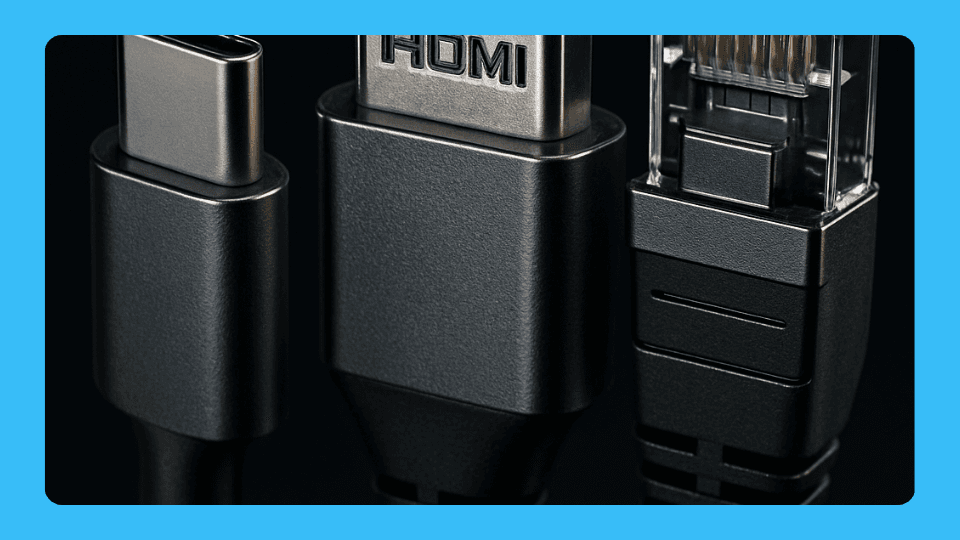
Getting a "No signal" message on your Samsung TV's HDMI input is frustrating, especially when everything was working fine yesterday. Modern HDMI connections are surprisingly sensitive to cable quality, port capabilities, and even the order you power devices on.
Quick answer
• Check the correct input — verify your TV is on the right HDMI port • Reseat the HDMI cable — unplug and firmly reconnect both ends • Try a different HDMI port — use the highest-bandwidth port (usually labeled HDMI 2.1 or 4K) • Power cycle everything — turn off TV and source device, unplug for 30 seconds, then restart • Test with a certified Ultra High Speed HDMI cable — older cables often fail at 4K or high refresh rates
Symptoms
• TV displays "No signal" message on HDMI input • Black screen when switching to HDMI source • Picture worked yesterday but fails today • Audio plays but no video appears • Signal cuts out intermittently during use
Quick checks
Confirm the correct input — Double-check that your Samsung TV is set to the HDMI input where your source device is actually connected. It's easy to accidentally switch to the wrong port.
Inspect the HDMI cable — Look for sharp bends, kinks, or loose connectors. Remove and firmly reconnect both ends until they click into place.
Test with known-working devices — Plug a streaming stick or other device into the same HDMI port, or connect your source to a different TV. This quickly identifies whether the problem is with the TV or source device.
Restart all devices — Power off the TV, source device, and any receiver or soundbar in between. Unplug everything for 30 seconds before turning back on.
Step-by-step fix
-
Start with a direct connection — If you normally connect through a receiver or soundbar, temporarily connect the source straight to the TV with a short HDMI cable. This eliminates variables while troubleshooting.
-
Use the highest-bandwidth HDMI port — Many Samsung TVs only support full 4K or 4K120Hz on specific inputs. Check your TV manual for ports labeled "HDMI 2.1," "4K 120," or "eARC" and connect there first.
-
Set conservative video settings — On your source device, set the output to 1080p or 4K at 60Hz initially. Once you get a picture, you can increase to higher frame rates.
-
Disable advanced HDMI features temporarily — Turn off VRR (Variable Refresh Rate), ALLM (Auto Low Latency Mode), and deep color modes while testing. These features can cause handshake failures.
-
Follow proper power-on sequence — Turn on the Samsung TV first and wait for the home screen to appear. Then power on any receiver (if used), and finally turn on the source device. Some device combinations are sensitive to startup order.
-
Test with a certified cable — Swap to a short, certified Ultra High Speed HDMI cable. Many "no signal" problems are actually marginal cables that fail at 4K or higher refresh rates.
If it still isn't working
After trying different cables, ports, and basic settings, persistent "No signal" issues usually indicate a failing HDMI port or deeper compatibility problem. Document which combinations work — note which source devices, HDMI ports, and cables succeed or fail. This information is crucial when contacting Samsung support or requesting warranty service.
Check for firmware updates on both your Samsung TV and source devices. Consider a factory reset of the TV as a last resort, but back up your picture settings first.
FAQ
Why did my HDMI connection stop working suddenly? HDMI cables can degrade over time, especially when bent repeatedly. Additionally, firmware updates on either device can change HDMI compatibility requirements.
Which HDMI port should I use on my Samsung TV? Use the port with the highest bandwidth rating, typically labeled "HDMI 2.1," "4K 120," or similar. This port usually supports the full range of resolutions and refresh rates.
Do I need an expensive HDMI cable? No, but you need a properly certified one. Look for "Ultra High Speed HDMI" certification for 4K content. Cheap uncertified cables often cause "no signal" problems.
Why does unplugging and reconnecting fix the problem temporarily? This forces a new HDMI handshake between devices. If the fix is temporary, the cable or port is likely failing and needs replacement.