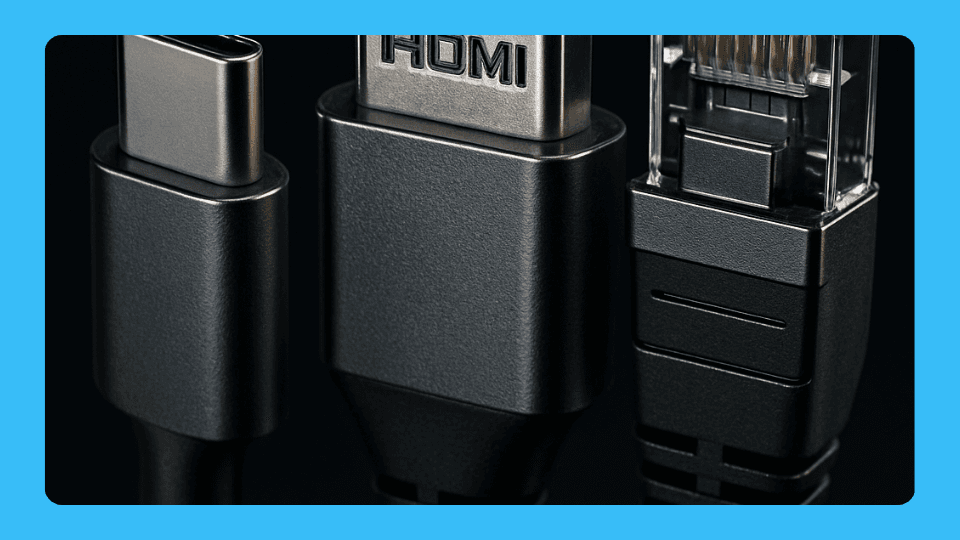
HDMI handshake problems between different brands are common because each manufacturer names their "Enhanced" modes and CEC features differently. The root cause is usually mismatched high-bandwidth settings or incompatible feature combinations between your TV, receiver, and source device.
Quick answer
- Enable brand-specific enhanced mode on the TV port (Sony: "Enhanced format (VRR)," Samsung: "Input Signal Plus," LG: "HDMI Deep Color")
- Use a certified Ultra High Speed HDMI cable — older cables often fail at 4K or higher refresh rates
- Connect source directly to TV first to bypass receiver variables during troubleshooting
- Power devices in order: TV first, then receiver, then source device
- Start with basic settings (1080p/4K60) before enabling VRR, ALLM, or deep color
Symptoms
- TV displays "No signal" despite cable being connected
- Picture works sometimes but cuts out randomly
- Audio works but screen stays black
- Switching inputs causes signal loss
- 4K or high refresh rate content fails while 1080p works
Quick checks
- Confirm the correct input — Check both TV input and receiver input. If CEC is enabled (Bravia Sync/Anynet+/Simplink), wrong inputs can auto-select
- Inspect the HDMI cable — Look for sharp bends, kinks, or loose connectors. Reseat both ends until they click into place
- Test another HDMI source or display — Plug a known-working device into the same port, or test your source on a different TV
- Restart everything — Power off all devices, unplug for 30 seconds, then turn back on
Step-by-step fix
- Start with a direct connection — If using a receiver or soundbar, temporarily connect the source straight to the TV with a short HDMI cable
- Enable the brand-specific high-bandwidth port mode — Sony: Settings → Watching TV → External inputs → HDMI signal format → Enhanced format (VRR); Samsung: Settings → General → External Device Manager → Input Signal Plus → On; LG: Settings → General → HDMI Settings → HDMI Deep Color → On
- Set conservative resolution first — Configure source to 1080p or 4K at 60Hz to establish stable handshake
- Disable advanced features temporarily — Turn off VRR, ALLM, and deep color modes in source device settings while testing
- Power on in clean order — Turn on TV first and wait for home screen, then power on receiver (if used), finally turn on source device
- Test with certified cable — Swap to a short, certified Ultra High Speed HDMI cable to rule out bandwidth limitations
- Gradually re-enable features — Once picture is stable, incrementally turn on advanced features like VRR and higher refresh rates
If it still isn't working
After verifying cables, ports, and basic resolution settings, persistent "No signal" behavior usually points to hardware failure or deeper compatibility issues. Document which combinations of source, port, and cable work or fail — this matrix helps when contacting manufacturer support and can justify warranty repairs when simple fixes are exhausted.
Diagnose the problem component:
- Source device issue: TV shows "No signal" on multiple ports, but other devices work fine in same ports
- TV problem: Multiple inputs lose signal intermittently with every device — check for firmware updates and consider factory reset
- Receiver/switch issue: Problems only occur with receiver in chain — test direct TV connection and review receiver's 4K/8K pass-through settings
FAQ
Why does my HDMI cable work sometimes but not others? Marginal cables often fail only at 4K or higher refresh rates due to insufficient bandwidth. The cable may handle 1080p fine but drop signal when pushed to full capacity.
Do I need to enable enhanced mode on every HDMI port? Yes, enhanced modes are typically configured per-port. Enable the setting on each port you plan to use for 4K or high refresh rate sources.
Why does power-on order matter for HDMI handshakes? Some devices need to detect the display capabilities during startup. Powering the TV first ensures the source device can properly negotiate resolution and features during its boot sequence.
Can firmware updates fix HDMI handshake problems? Yes, manufacturers regularly release updates that improve HDMI compatibility. Check for updates on your TV, receiver, and source devices if you're experiencing persistent issues.