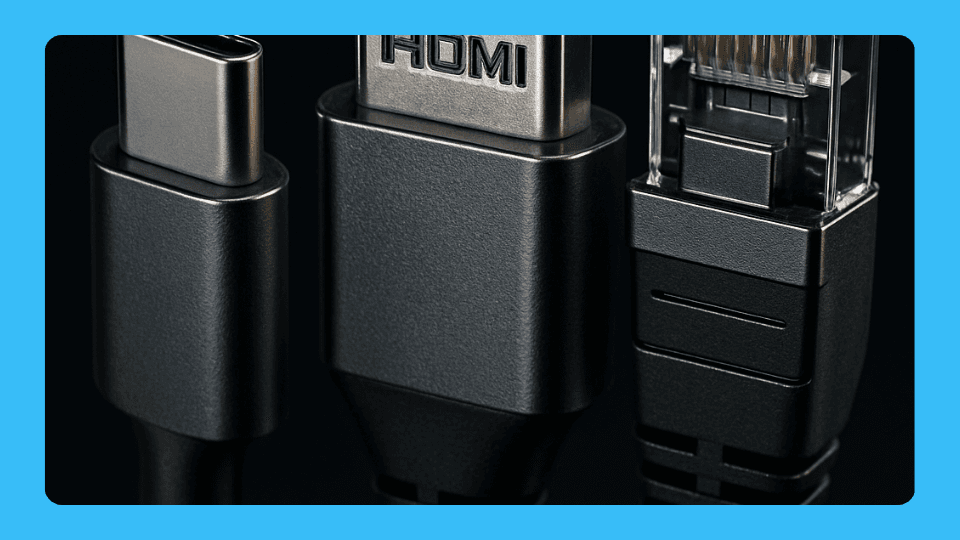
When you see "No Signal" on your TV's HDMI input, it's almost always one of three issues: wrong input selected, a bad HDMI connection (cable or port), or a handshake problem between devices trying to negotiate video formats. The key is systematically isolating each part of your setup to find where the chain breaks.
Quick answer
- Check the correct input — make sure your TV is on the right HDMI port
- Test the TV port directly — connect a known-good device to verify the port works
- Simplify the chain — connect source directly to TV, bypassing any receivers or switches
- Cold-boot everything — unplug all devices for 60 seconds, then power on TV first, receiver second, source last
- Enable Enhanced mode — turn on "Enhanced format" or "Deep Color" for the HDMI port
- Step up features gradually — start with 1080p, then add 4K, HDR, and high refresh rates one at a time
Symptoms
- TV displays "No Signal" message on specific HDMI input
- Picture flashes briefly then disappears
- Video works at 1080p but fails when switching to 4K/HDR
- Signal works when connected directly to TV but fails through receiver or switch
- Picture appears after unplugging everything but disappears again later
- Video worked fine until you changed cables, added equipment, or updated firmware
Quick checks
Verify the basics first:
- Confirm TV is set to correct HDMI input (HDMI 1, HDMI 2, etc.)
- Check if other HDMI ports on the TV work with the same source
- Test a different device (streaming stick, game console) on the problematic port
Simple isolation test:
- Connect your source directly to the TV, bypassing any receivers, switches, or soundbars
- If direct connection works, the middle device is your problem
- If direct connection fails, focus on the source device, cable, or TV port settings
Step-by-step fix
-
Confirm correct TV input
- Use TV remote to cycle through inputs (Input or Source button)
- Match the input name to where your cable is physically connected
- Some TVs auto-switch inputs and may have timed out to a different source
-
Test the TV port with known-good device
- Connect a streaming stick, game console, or other working device to the same HDMI port
- If the test device works, your TV port is fine — focus on your original source/cable
- If nothing works on that port, try a different HDMI port on your TV
-
Remove middle devices from the chain
- Disconnect from any receivers, HDMI switches, or soundbars
- Connect source directly to TV with a short HDMI cable
- If this works, your receiver/switch is the bottleneck — skip to step 7
-
Perform complete cold boot
- Unplug power cables from TV, source device, and any receivers/switches
- Wait 60 seconds for all capacitors to discharge
- Power on in this order: TV first (let it fully boot), then receiver/switch, then source device
- This forces a fresh HDMI handshake between all devices
-
Enable Enhanced HDMI mode on TV
- Go to TV Settings → Picture/Display → HDMI settings (exact path varies by brand)
- Look for "Enhanced format," "HDMI Deep Color," "4K Enhanced," or "HDMI 2.1 mode"
- Enable this setting for the HDMI port you're using
- This is required for 4K/HDR/120Hz content
-
Test features in controlled steps
- Start with 1080p SDR output from your source
- Once stable, change source to 4K SDR
- Add HDR if that works
- Finally enable 120Hz/VRR if supported
- If it fails at any step, the previous working mode shows your bandwidth limit
-
Configure receiver/switch passthrough (if using middle device)
- Access receiver Settings → Video → HDMI or similar menu
- Set video processing to "Through," "Direct," or "Bypass" mode
- Enable "4K Enhanced," "8K mode," or "HDMI 2.1" on relevant input/output ports
- Disable any scaling or video conversion features
-
Test with certified HDMI cable
- Try a short (3-6 feet), high-speed certified HDMI cable
- For 4K/120Hz, ensure cable is rated for 48Gbps (HDMI 2.1)
- If new cable works, your original cable was the limiting factor
-
Remove adapters and converters
- Take out any HDMI adapters, USB-C to HDMI dongles, or format converters
- Test with direct HDMI connection
- If this fixes it, the adapter was causing handshake issues
If it still isn't working
Create a compatibility matrix to isolate the problem:
- Test different combinations of TV ports, source devices, and cables
- Note which combinations work and which fail
- Look for patterns (fails only with 4K, fails only through receiver, etc.)
Update firmware as last resort:
- Update TV firmware through Settings → Support → Software Update
- Update receiver/switch firmware if available
- Check that HDMI Enhanced settings didn't reset after updates
Check power-up timing:
- If using ARC/eARC audio, ensure TV powers on before the receiver
- Some devices need specific power-on sequences to establish proper handshake
FAQ
Why does the picture work sometimes but not others? HDMI handshakes can be timing-sensitive. If your source device wakes up faster than your TV or receiver, they may negotiate incompatible settings. A cold boot forces them to renegotiate properly.
My old HDMI cable worked fine before — why not now? Cables don't "go bad" suddenly, but requirements change. If you upgraded to 4K/HDR or added a receiver, your old cable may not have enough bandwidth for the new signal path, even if it handles 1080p fine.
Should I factory reset my TV to fix HDMI issues? Not usually. HDMI problems are almost always about port settings, cables, or device compatibility. Try enabling Enhanced mode on the specific HDMI port first — this fixes most 4K/HDR issues without losing your TV settings.
Why does it work direct to TV but not through my receiver? Your receiver may be in Standard HDMI mode instead of Enhanced/4K mode, or it may not support the full bandwidth your source is trying to send. Check the receiver's HDMI input/output settings and enable any 4K or Enhanced modes.