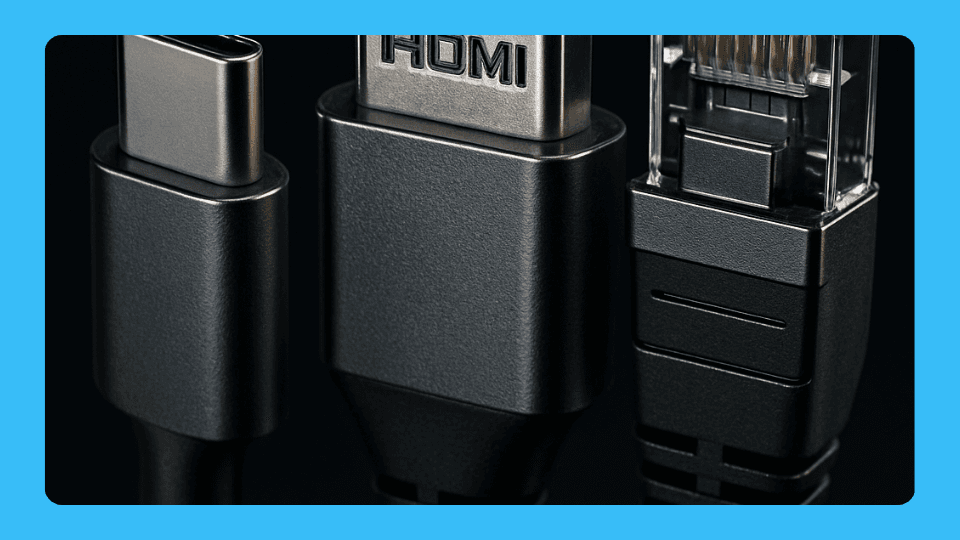
Getting 4K120 or VRR working with modern consoles and TVs can feel like solving a puzzle. One wrong setting or cable can drop you back to 4K60 or even 1080p, and sometimes the screen just goes black when you enable the higher refresh rate. The root cause is usually a mismatch in the HDMI chain — wrong port, incompatible cable, or conflicting settings between your console and display.
Quick answer
- Use the correct HDMI port — only specific ports support full HDMI 2.1 bandwidth
- Replace with Ultra High Speed HDMI cable — 4K120 requires more bandwidth than standard cables
- Enable enhanced HDMI mode on your TV for the port you're using
- Update firmware on both console and TV before troubleshooting
- Test console direct to TV before blaming receivers or switches
Symptoms
- Console reports 4K120 or VRR as "not supported" despite TV advertising these features
- Screen goes black when switching from 4K60 to 4K120 mode
- Games automatically drop to 1080p when VRR is enabled
- Picture works fine at 4K60 but fails at higher refresh rates
- Xbox or PlayStation test screens show red indicators for 4K120/VRR
Quick checks
Confirm the port supports 4K120/VRR — Many TVs only support full-bandwidth HDMI 2.1 on one or two ports. Look for labels like "4K 120," "Game," or "HDMI 2.1" in the manual.
Use a certified Ultra High Speed HDMI cable — 4K120 and VRR push far more data than 4K60. A cable that worked fine before can fail at higher refresh rates.
Update firmware on the console and TV — Both sides have shipped fixes for VRR and 4K120 stability. Install any pending updates before deeper troubleshooting.
Step-by-step fix
-
Connect console to TV's best HDMI 2.1 port — Check your TV manual for which port supports full bandwidth (usually HDMI 3 or 4)
-
Enable enhanced HDMI mode on TV — Go to Settings → HDMI → Input Format and select "Enhanced" or "4K120" mode for your console's port
-
Set console to 4K60 first — Choose 4K (UHD) at 60 Hz with HDR enabled. Confirm this is stable before enabling higher refresh rates
-
Enable 120 Hz gradually — Once 4K60 is solid, enable 120 Hz mode. If the screen goes black, roll back and check your cable
-
Test VRR separately — After 4K120 works, try enabling VRR. Test one feature at a time to isolate problems
-
Disable ALLM if picture drops — Some TVs interact poorly with Auto Low Latency Mode. Turn it off temporarily while stabilizing the connection
-
Turn off heavy processing — Disable motion smoothing, noise reduction, and other intensive picture processing that can interfere with gaming modes
If it still isn't working
Test console direct to TV — Before assuming your receiver is broken, connect the console directly to the TV's best HDMI 2.1 port. If 4K120/VRR works there but fails through the receiver, you've found a bandwidth limitation.
Try a different cable — Even certified cables can fail. Swap in a known-good Ultra High Speed HDMI cable to rule out cable issues.
Check receiver passthrough settings — In your receiver's HDMI settings, enable "8K/4K Enhanced" or the highest bandwidth mode. Some older receivers cannot pass 4K120 signals.
Consider staying at 4K60 + VRR — If 4K120 keeps failing but 4K60 with VRR is stable, the more reliable mode may be worth keeping rather than chasing small gains.
Getting the Most from Your Home Theater?
Our best streaming device guide and best AV receivers guide cover the hardware upgrades that solve most persistent HDMI, eARC, and audio passthrough issues at the source.
FAQ
Why does my Xbox say 4K120 isn't supported when my TV advertises it?
Your TV probably only supports 4K120 on specific HDMI ports. Check which port you're using and enable enhanced mode for that input.
Can I use my old HDMI cable for 4K120?
No. 4K120 requires Ultra High Speed HDMI cables rated for 48 Gbps. Older cables will drop to lower resolutions or lose signal entirely.
Should I enable VRR and 4K120 at the same time?
Enable them one at a time first. Get 4K120 stable, then add VRR. Some TV and console combinations work better with just VRR at 4K60.
My receiver worked fine for 4K60 but fails at 4K120. Is it broken?
Not broken, just limited. Many receivers from 2019-2020 can't pass full 40+ Gbps signals needed for 4K120. Check if yours has a firmware update or consider upgrading.