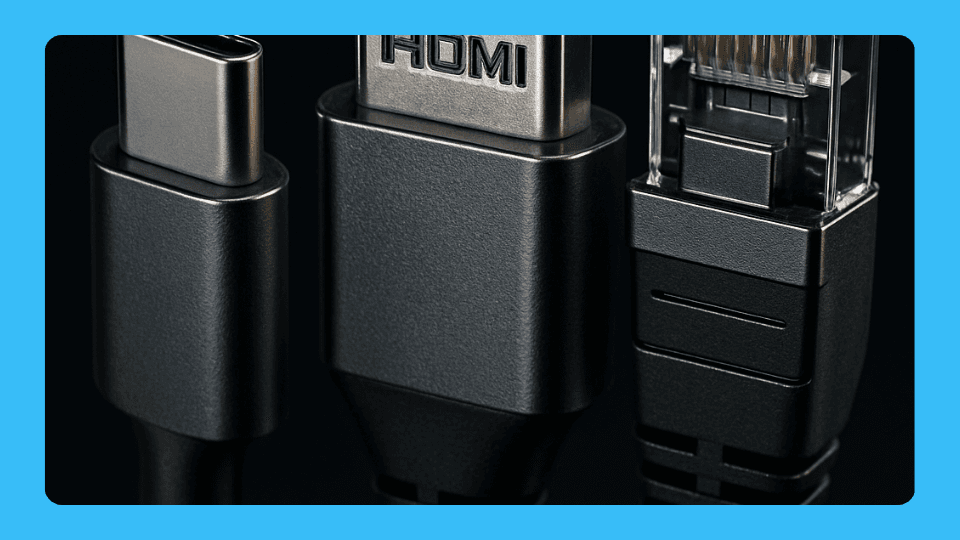
When your HDMI setup shows "No Signal" with a receiver, soundbar, or HDMI switch in the chain, the problem is usually routing mistakes or EDID handshake issues rather than hardware failure. Mixed-brand setups are especially prone to Enhanced mode toggles and power-up sequence problems that get overlooked in basic troubleshooting.
Quick answer
- Check Enhanced/8K mode — Toggle the receiver or switch HDMI output to Enhanced/8K/4K120 mode
- Test direct connection — Bypass the middle device and connect source straight to TV
- Power cycle everything — Turn off all devices, unplug for 30 seconds, power on TV first
- Try certified Ultra High Speed HDMI cable — Marginal cables fail at 4K/higher refresh rates
- Match resolution settings — Start with 1080p or 4K 60Hz, disable VRR/ALLM while testing
Symptoms
- TV displays "No Signal" when source runs through receiver/soundbar but works when connected directly
- Signal drops only during HDR content or high refresh rate gaming
- Audio passes through but video shows black screen or "No Signal"
- Connection worked before but fails after power outage or firmware update
- Some sources work through the chain but others don't
Quick checks
- Confirm the correct input — Make sure the receiver or switch is on the input you expect, not just the TV. Some AVRs silently fall back to the last used source after power loss
- Inspect the HDMI cable — Look for sharp bends, kinks, or loose connectors. Try reseating both ends until they click into place, especially on the AVR's HDMI Out jack
- Test another HDMI source or display — Move the same cable to a known-working streamer or console, or plug your source into a different TV. If it only fails through the middle box, that box is the bottleneck
- Restart everything — Power off the TV, the source device, and any receiver or switch in between. Unplug them for 30 seconds before turning them back on
Step-by-step fix
-
Start with a direct connection — If you normally run through a receiver or soundbar, temporarily connect the source straight to the TV with a short HDMI cable. This removes one variable while you troubleshoot
-
Put the middle device in Enhanced/8K mode — On most receivers and switches, navigate to Settings → Video → HDMI Output and set to Enhanced/8K/4K120 for full bandwidth. Toggle that mode off/on, then retry the chain
-
Match resolution and refresh rate — Set the source to a conservative resolution first — try 1080p or 4K at 60 Hz. Once you see a picture, you can step back up to higher frame rates
-
Disable extras while testing — Turn off VRR, ALLM, and vendor-specific features like Instant Game Response until you have a stable signal. Add them back one at a time
-
Power on in a clean order — Turn on the TV first and let it reach the home screen. Then power on the receiver or switch, and finally the source. Some combinations really do depend on power-up order
Expert tip: A surprising number of no-signal problems end up being a marginal HDMI cable that only fails at 4K or at higher frame rates. Swapping to a short, certified Ultra High Speed HDMI cable is one of the fastest ways to tell whether you are chasing a wiring problem or a device issue.
Scenario example: A cable box runs through a Denon receiver into HDMI 3 on the TV. It shows "No signal" whenever HDR channels play. Switching the Denon HDMI output to "8K Enhanced," moving the TV cable to the eARC/4K120 port, and using a Certified Ultra High Speed HDMI cable clears the issue while keeping audio through the receiver.
If it still isn't working
After verifying cables, ports, and basic resolution settings, persistent "No Signal" or black screen behavior usually points to a failing port or a deeper compatibility issue. Document which combinations of source, port, and cable work or fail. Having that matrix ready makes support with your TV or receiver manufacturer far more effective and can help justify a warranty repair or replacement when simple fixes are exhausted.
Identify the problem device:
- Source device problem — If the TV shows "No signal" no matter which port you try, but other devices work fine in the same port, the console or streamer may be at fault
- TV problem — If multiple inputs intermittently lose signal for every device, check for a TV firmware update and consider a full factory reset after backing up your picture settings
- Receiver or switch problem — If things only fail when a receiver or HDMI switch is in the chain, connect the source directly to the TV. If that works, review the receiver's video pass-through and 4K/8K settings
Getting the Most from Your Home Theater?
Our best streaming device guide and best AV receivers guide cover the hardware upgrades that solve most persistent HDMI, eARC, and audio passthrough issues at the source.
FAQ
Why does my signal work sometimes but not others? Intermittent signals usually indicate a marginal HDMI cable or Enhanced mode mismatch. The connection barely works at lower resolutions but fails when 4K HDR or high refresh rates demand more bandwidth.
Do I need to replace my receiver if direct connection works? Not necessarily. Most "failing" receivers just need Enhanced/8K mode enabled or a firmware update. Check the manufacturer's website for HDMI 2.1 compatibility updates before replacing hardware.
Should I factory reset my devices? Try the power cycle and Enhanced mode steps first. Factory resets erase all your settings and rarely fix HDMI handshake issues that these targeted fixes don't resolve.
Can a bad HDMI cable damage my equipment? No, but a marginal cable will cause exactly these symptoms. Cables either work or they don't — there's no gradual degradation that harms connected devices.
Need better HDMI cables? See our Best HDMI Cables guide for certified options that fix most signal issues.