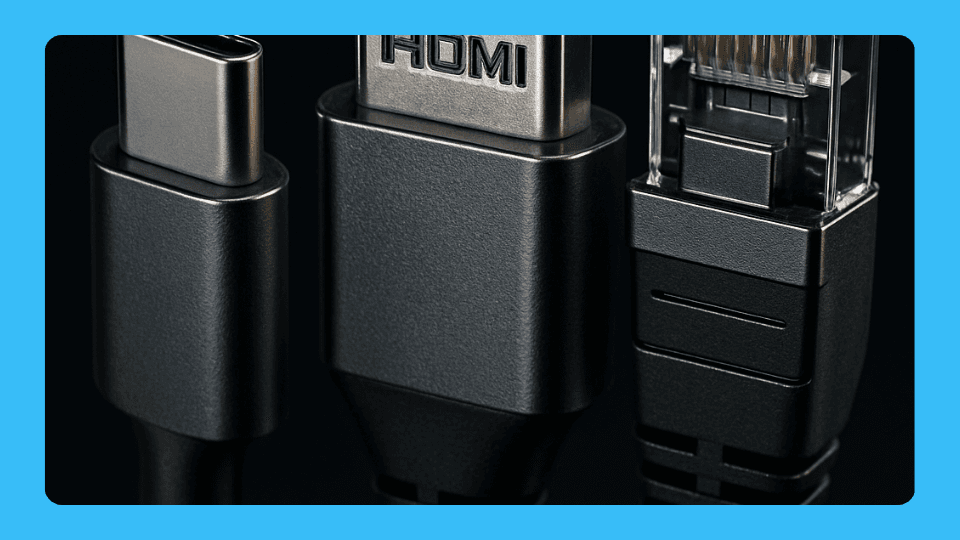
An HDMI splitter takes one source and sends the same signal to multiple TVs simultaneously. This is useful for sports bars, waiting rooms, multi-room setups, or sending your cable box to both the living room and bedroom TV. Here's what to know before buying and which splitters actually work reliably.
Quick answer
- Best overall (4K@120Hz): OREI BK-102 — HDMI 2.1, 48Gbps, HDCP 2.3, downscaling (~$45-55)
- Best 4-output: J-Tech Digital 8KSP14E — four TVs, HDMI 2.1, 4K@120Hz (~$67)
- Best mid-range (4K@60Hz): J-Tech Digital 4KSP2 — multi-resolution output, HDCP 2.2 (~$27-30)
- Best budget: avedio links 1x2 — 4K@60Hz, auto downscaling, plug-and-play (~$13-17)
- Best with audio extraction: SIIG CE-H27N11 — HDMI 2.1 + optical/RCA audio out (~$50-70)
HDMI splitter vs HDMI switch — don't confuse them
This is the most common mistake people make:
- HDMI splitter: 1 input, multiple outputs. One source goes to multiple TVs. All TVs show the same picture.
- HDMI switch: Multiple inputs, 1 output. Multiple sources connect to one TV. You choose which source to display.
If you want to send your PS5 to both your gaming monitor and your living room TV, you need a splitter. If you want to connect your PS5, Xbox, and Apple TV to one TV that only has two HDMI ports, you need a switch.
What to look for
HDCP compliance is critical
HDCP (High-bandwidth Digital Content Protection) is copy protection built into HDMI. Streaming services (Netflix, Disney+, Amazon Prime), cable boxes, and Blu-ray players all use HDCP. If your splitter doesn't support HDCP, you'll see a black screen or "HDCP error" instead of your content.
- HDCP 1.4: Minimum for 1080p content
- HDCP 2.2: Required for 4K streaming content
- HDCP 2.3: Required for some newer 4K/8K sources
Always buy a splitter with at least HDCP 2.2 support — this covers all current 4K streaming and Blu-ray content.
Resolution and refresh rate
Match your splitter to your source's output:
- 4K@30Hz: Budget splitters. Fine for cable boxes and older devices.
- 4K@60Hz: The standard for streaming devices (Apple TV 4K, Roku, Fire TV 4K) and Blu-ray players. Most setups need this.
- 4K@120Hz (HDMI 2.1): Required for PS5 and Xbox Series X at full capability. Premium splitters only.
EDID management
EDID tells the source what resolutions the connected TV supports. With a splitter, the source sees two TVs that might support different resolutions. Good splitters handle EDID management to prevent handshake issues — they report the lowest common resolution to the source so both TVs work.
Powered vs unpowered
Always buy a powered splitter for 4K. Unpowered (passive) splitters split the signal voltage and cause signal degradation, especially with longer cable runs. A powered splitter amplifies the signal to maintain quality on all outputs.
Our picks
OREI BK-102 — best overall
The OREI BK-102 is a full HDMI 2.1 splitter with 48Gbps bandwidth — it handles 4K@120Hz for gaming and 8K@60Hz for future-proofing. HDCP 2.3 means streaming content works without black screens. The built-in downscaling lets you connect one 4K TV and one 1080p TV simultaneously without issues. EDID management prevents handshake problems.
Pros: Full HDMI 2.1 (4K@120Hz, 8K@60Hz), HDCP 2.3, downscaling for mixed displays, EDID management, OREI is well-established Cons: More expensive than HDMI 2.0 splitters, requires external 5V power supply, 2 outputs only Price range: $45-55
J-Tech Digital 8KSP14E — best 4-output
For sports bars, waiting rooms, or multi-room setups, the J-Tech 8KSP14E sends one HDMI 2.1 source to four TVs at up to 4K@120Hz. Three EDID modes (Auto/Copy/Downscale) handle mixed displays. Compact aluminum housing runs cool. HDCP 2.3 and full HDR10+/Dolby Vision passthrough.
Pros: 4 outputs at HDMI 2.1 speeds, 4K@120Hz, EDID management with downscaling, aluminum build, J-Tech is well-regarded Cons: No audio extraction, priciest on this list, occasional EDID handshake quirks with mixed-resolution setups Price range: ~$67
J-Tech Digital 4KSP2 — best mid-range (4K@60Hz)
If you don't need 4K@120Hz, the 4KSP2 is the value sweet spot. Its standout feature is Multi-Resolution Output (MRO) — each output can run at a different resolution simultaneously (e.g., Output 1 at 4K, Output 2 at 1080p). HDCP 2.2/2.3 handles streaming content. HDR10 and Dolby Vision passthrough.
Pros: Multi-Resolution Output, HDCP 2.2/2.3, HDR10 + Dolby Vision, excellent reliability, under $30 Cons: HDMI 2.0 only (4K@60Hz max, no 120Hz), no VRR/ALLM for gaming, 2 outputs only Price range: $27-30
avedio links 1x2 — best budget
The avedio links 4K@60Hz splitter handles HDMI 2.0b with HDCP 2.2 and auto downscaling for under $17. USB powered with included power adapter. For basic multi-TV setups where you're splitting a cable box or streaming device, it's hard to beat the value.
Pros: Extremely affordable, 4K@60Hz with HDCP 2.2, auto downscaling, USB powered, plug-and-play Cons: No EDID management (can cause handshake issues with picky displays), no audio extraction, basic plastic build, keep cables under 15 feet Price range: $13-17
SIIG CE-H27N11 — best with audio extraction
If you need to split video to two TVs AND extract audio for a soundbar or older receiver, the SIIG adds optical S/PDIF and analog RCA audio outputs. HDMI 2.1 with 40Gbps bandwidth handles 4K@120Hz. VRR and ALLM support for gaming. EDID management with downscaling.
Pros: Audio extraction (optical + RCA), HDMI 2.1, VRR/ALLM, EDID management, aluminum housing Cons: 40Gbps (not full 48Gbps), bulkier due to audio hardware, higher price Price range: $50-70
Troubleshooting common splitter issues
Black screen on one or both TVs
- Check HDCP compatibility — make sure your splitter supports HDCP 2.2 for 4K content
- Try different HDMI cables — a bad cable on one output can affect both
- Power cycle the splitter — unplug it for 30 seconds, then reconnect
One TV shows lower resolution
- This is an EDID issue — the splitter defaults to the lowest common resolution. If one TV is 4K and the other is 1080p, both may show 1080p. Use a splitter with EDID management to force higher resolution on the capable TV.
Audio issues with splitter
- Splitters duplicate the full HDMI signal including audio. If one TV is connected to a soundbar via ARC/eARC, the splitter shouldn't affect audio. If you're getting no audio, check that your source's audio output settings match your playback device.
FAQ
Can I use an HDMI splitter with Netflix/streaming apps?
Yes, as long as your splitter supports HDCP 2.2 (for 4K content) or HDCP 1.4 (for 1080p). All our recommended splitters handle HDCP properly.
Will a splitter add input lag for gaming?
Powered splitters add negligible lag (under 1ms). For competitive gaming at 4K@120Hz, use the ViewHD HDMI 2.1 splitter to maintain full bandwidth and VRR support.
Can I send different content to different TVs?
No — a splitter sends the same signal to all outputs. For different content on different TVs, you need separate sources or a matrix switcher (which routes multiple inputs to multiple outputs independently).
How long can my HDMI cables be with a splitter?
For passive HDMI cables at 4K@60Hz, keep each run under 15 feet. For longer runs, use active HDMI cables or fiber optic HDMI cables. The splitter's signal amplification helps, but cable quality on each output matters.